


ID: 100014317
USB Common Access
EAN
881317512482
In stock: 10-19
Delivery: 2–4 weeks
Smart Card Reader / CAC Reader
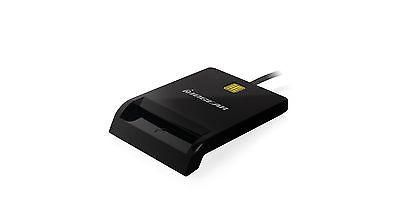
IOGEAR's USB Common Access Card Reader is the perfect solution for most civilians as well as non-military government workers who need everyday secure access. Common Access Card (CAC), or Smart Card readers are often used as a communications medium between the EMV smart card and a host (e.g. a computer, a point-of-sale terminal, network login, etc.) in secure systems such as those used by government, banking and health care.
The GSR212 requires the card to be inserted directly into the reader where electrical contacts retrieve the data stored in the card’s chipset. IOGEAR’s physical contact readers are less prone to misalignment, which helps to eliminate the possibility of being misread.
What is a Smart Card or Common Access Card?
Often referred to as a Smart Card, the Common Access Card (or CAC) is the next generation in secure identification technology. Having the same shape as a credit card, every Smart Card features an embedded data chip allowing the user's identification to be electronically verified when accessing secured systems. In addition to the embedded chip, Smart Cards are usually programmed with a PIN to ensure security for both the card holder and the system being accessed. Unlike the magnetic strips found on traditional credit cards, the EMV cards uses multiple layers of security. This chip and pin technology provides higher security by storing more encrypted data, avoiding data breach. IOGEAR's USB Common Access Card Reader (Non-TAA) uses a contact system where the card must be inserted directly into the card reader; this type of reader is less prone to misalignment and eliminates the possibility of being misread. When it comes to secure access, the Common Access Card (or Smart Card) is an evolutionary step in convenience and security.
Having reached tremendous adoption rates outside of the U.S., Smart Cards are now rapidly growing in this country to combat credit card fraud, while also providing next generation security and user friendly identification. The federal government issues Common Access Cards programmed with a Personal Identification Verification (PIV) chip containing the data necessary for the cardholder to be properly identified and granted access to secure federal facilities and information systems. Smart Cards have been in use by the federal government in accordance with Homeland Security Presidential Directive 12 (HSPD-12) since 2006, and now the technology is rapidly spreading to banking, healthcare and other areas requiring identity verification and secured access.
- Support EMV Level 1 specification
- Designed for use with CAC middleware (not included)
- Supports PC Smart Card industry standard - PC/SC version 1.0/2.0
- ISO7816 implementation - Class A, B, and C (5V / 3V / 1.8V) Card
- Support T0, T1 protocol
- EMV 4.1 compliant
- Supports popular memory cards including: SLE 4404, 4418, 4428, 4442, 4443, and I2C
- Support short APDU and extended APDU
- Compatible with Microsoft USB-CCID driver
- Compliant with USB CCID Transport Specification Rev 1.1
- Low power consumption
- Display function: LED display to show system operation and power status
- Dual Multi-protocol Smart Card Interface: Main Card & Auxiliary Card
- Compliant with ISO 7816, EMV2000, GIE-CB and WHQL Standards.
- Asynchronous Protocol T=0 & T=1, with Direct and Inverse Modes.
- Supports CPU-based cards with ISO 7816 T=0 and T=1protocol and 2 and 3 wire Memory Cards or 12C interface synchronous card
- FIPS-201 Compliant
- Suitable for applications in government, healthcare, banking, and secure network login
IOGEAR's USB Common Access Card Reader is the perfect solution for most civilians as well as non-military government workers who need everyday secure access. Common Access Card (CAC), or Smart Card readers are often used as a communications medium between the EMV smart card and a host (e.g. a computer, a point-of-sale terminal, network login, etc.) in secure systems such as those used by government, banking and health care.
The GSR212 requires the card to be inserted directly into the reader where electrical contacts retrieve the data stored in the card’s chipset. IOGEAR’s physical contact readers are less prone to misalignment, which helps to eliminate the possibility of being misread.
What is a Smart Card or Common Access Card?
Often referred to as a Smart Card, the Common Access Card (or CAC) is the next generation in secure identification technology. Having the same shape as a credit card, every Smart Card features an embedded data chip allowing the user's identification to be electronically verified when accessing secured systems. In addition to the embedded chip, Smart Cards are usually programmed with a PIN to ensure security for both the card holder and the system being accessed. Unlike the magnetic strips found on traditional credit cards, the EMV cards uses multiple layers of security. This chip and pin technology provides higher security by storing more encrypted data, avoiding data breach. IOGEAR's USB Common Access Card Reader (Non-TAA) uses a contact system where the card must be inserted directly into the card reader; this type of reader is less prone to misalignment and eliminates the possibility of being misread. When it comes to secure access, the Common Access Card (or Smart Card) is an evolutionary step in convenience and security.
Having reached tremendous adoption rates outside of the U.S., Smart Cards are now rapidly growing in this country to combat credit card fraud, while also providing next generation security and user friendly identification. The federal government issues Common Access Cards programmed with a Personal Identification Verification (PIV) chip containing the data necessary for the cardholder to be properly identified and granted access to secure federal facilities and information systems. Smart Cards have been in use by the federal government in accordance with Homeland Security Presidential Directive 12 (HSPD-12) since 2006, and now the technology is rapidly spreading to banking, healthcare and other areas requiring identity verification and secured access.
- Support EMV Level 1 specification
- Designed for use with CAC middleware (not included)
- Supports PC Smart Card industry standard - PC/SC version 1.0/2.0
- ISO7816 implementation - Class A, B, and C (5V / 3V / 1.8V) Card
- Support T0, T1 protocol
- EMV 4.1 compliant
- Supports popular memory cards including: SLE 4404, 4418, 4428, 4442, 4443, and I2C
- Support short APDU and extended APDU
- Compatible with Microsoft USB-CCID driver
- Compliant with USB CCID Transport Specification Rev 1.1
- Low power consumption
- Display function: LED display to show system operation and power status
- Dual Multi-protocol Smart Card Interface: Main Card & Auxiliary Card
- Compliant with ISO 7816, EMV2000, GIE-CB and WHQL Standards.
- Asynchronous Protocol T=0 & T=1, with Direct and Inverse Modes.
- Supports CPU-based cards with ISO 7816 T=0 and T=1protocol and 2 and 3 wire Memory Cards or 12C interface synchronous card
- FIPS-201 Compliant
- Suitable for applications in government, healthcare, banking, and secure network login
Recommended products

IOGEAR / MPN: GUB231
2-Port PrinterShare USB
Price on request

IOGEAR / MPN: GSR202
FIPS201 Certified USB Smart
Price on request

IOGEAR / MPN: GWAVR4K
Mini Wireless 4K Screen
Price on request

IOGEAR / MPN: GSTY103
Touch Point Stylus 3-pack
Price on request

IOGEAR / MPN: GUH3C4PD
USB-C to 4 Port USB-A
Price on request

IOGEAR / MPN: GUC232A
USB to Serial RS232 DB9Adapter
Price on request
You also viewed
Go to catalog →

MikroTik / MPN: RB952UI-5AC2ND-TC
hAP ac lite with 650MHz CPU,
Price on request

Kensington / MPN: 62401
Wristrest Duo Gel
Price on request

Lenovo / MPN: GY50X79385
Legion M600 Mouse
Price on request

Targus / MPN: APA108EU
USB-C 100W PD Charger, Black
Price on request

Compulocks / MPN: 11KS01KL
Galaxy Tab A9+ 11" Secured
Price on request

Sandberg / MPN: 630-13
Wireless Vertical Mouse Pro
Price on request